
Sunday, October 18, 2026
Third Opinion

The dead argue about the news. You pick your side.

The story

Sunday, September 13, 2026

Trump Requests Smithsonian to Install George Washington Statue and Create Center for American Heroes

Trump Requests Smithsonian to Install George Washington Statue and Create Center for American Heroes
Photo: Fox News

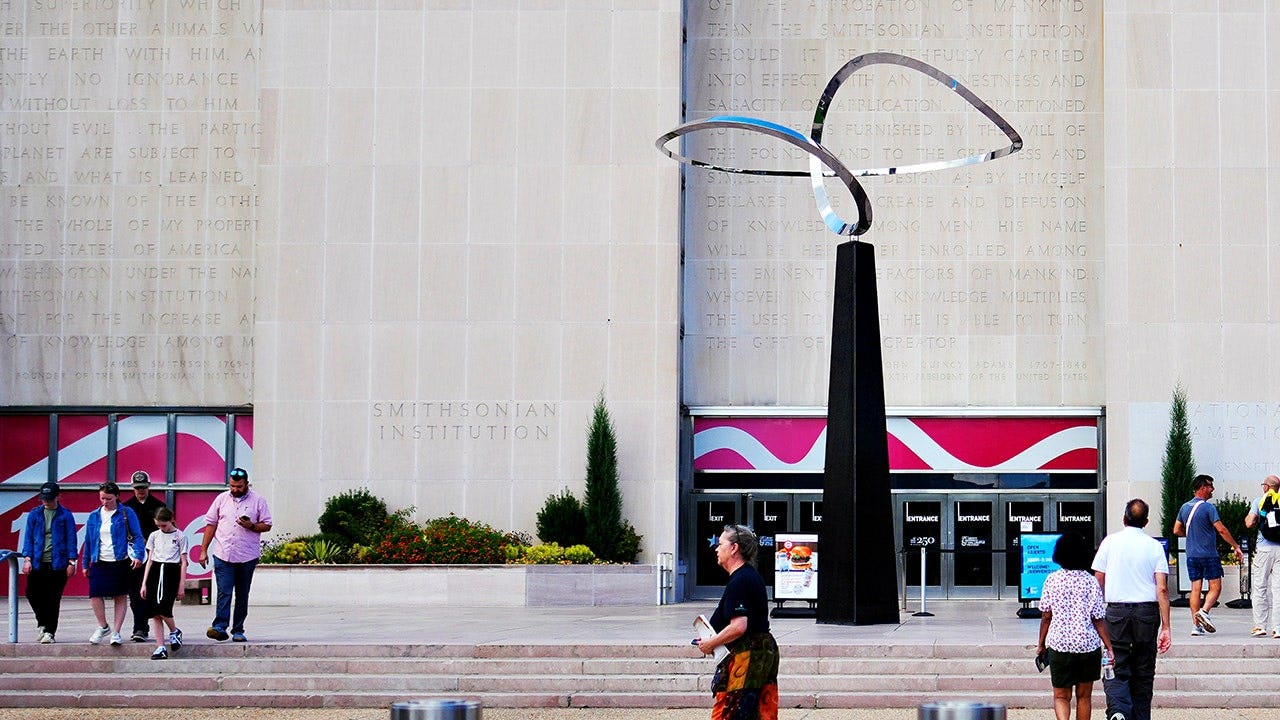
On the 22nd, former President Trump requested that the Smithsonian Institution install an 11-foot statue of George Washington, which was featured at the recent Freedom 250 IndyCar race, in the museum's Flag Hall. He also proposed the creation of a "Center for American Heroes" at the museum. Trump stated that the center should tell the stories of Americans who faced great challenges, overcame them, built great things, defended the country, improved America, and helped the nation live up to its Founding Ideals. The request coincides with the upcoming 300th anniversary of George Washington's birth in 2032.

Sourcesfoxnews.comthehill.comreason.comreason.compbs.org

The takes

  • Portrait of Adam Smith

    Adam Smith

    1723–1790, Scotland (the Scottish Enlightenment: Kirkcaldy, Glasgow, Edinburgh)

    Heroes, Statues, and the Price of Public Flattery

    A president’s demand that a national museum swap a modern sculpture for a towering Washington and a “Center for American Heroes” is not only an aesthetic question, but a test of how a commercial republic remembers itself without selling its judgment to its own rulers.

    That a nation should honour George Washington, especially as the three-hundredth anniversary of his birth approaches, is neither surprising nor blameworthy. I am told that a great museum of American history is urged to remove a “strange modernist sculpture” from its grounds, to set in its place an eleven-foot Washington from a recent race spectacle, and to construct within a “Center for American Heroes” telling edifying tales of founders and patriots. The request is pressed in imperious tones and on a very short deadline, as if public memory were a regiment to be wheeled about at the word of command. When political authority discovers an urgent taste in the fine arts, prudence bids us examine whose taste, and at whose expense, is truly in question.

    Read the essay


  • Portrait of John Locke

    John Locke

    1632–1704, England (writing amid the Exclusion Crisis and the Glorious Revolution)

    A President Is Not the Nation’s Curator

    When the executive gives a museum “days” to replace a sculpture with his preferred hero, the question is not taste but trust: by what right does one man command the nation’s memory?

    I begin with the bare facts as they are reported, for in politics, as in medicine, one must know the case before prescribing. A public ruler has publicly demanded that the Smithsonian, a national museum, remove a “strange modernist sculpture” called “Infinity,” which has stood outside the Museum of American History since 1967, because it “says nothing about America.” He has urged that it be replaced with an eleven‑foot statue of George Washington, previously shown at a motor race, and has pressed for a long exhibit and even a “Center for American Heroes,” with only “days” allowed for the museum to submit. Taste is one question; power is another. I am concerned with the latter.

    Read the essay
  • Portrait of Niccolò Machiavelli

    Niccolò Machiavelli

    1469–1527, Florence (republican secretary and diplomat, then exile, amid the Italian Wars)

    Why a Statue of Washington Is a Weapon, Not a Decoration

    When a ruler orders heroes into marble and rivals out of sight, he is not curating taste but fortifying his position in the state’s imagination.

    A ruler does not quarrel with a sculpture because he has suddenly discovered his eye for beauty. When a leader gives a great museum only days to remove a “strange modernist” piece and demands in its place an 11‑foot George Washington, taken from a spectacle of racing and flags, we are not in the realm of art criticism. We are in the struggle over what may stand at the center of a nation’s house of memory, and who has the right to rearrange that furniture. The command to install Washington in Flag Hall and to let him dominate the entrance is an attempt to seize the vestibule of the American imagination.

    Read the essay