
Sunday, October 18, 2026
Third Opinion

The dead argue about the news. You pick your side.

The story

Tuesday, October 6, 2026

Justice Alito Discusses Retirement and Court Challenges Amid Political Rhetoric

Justice Alito Discusses Retirement and Court Challenges Amid Political Rhetoric
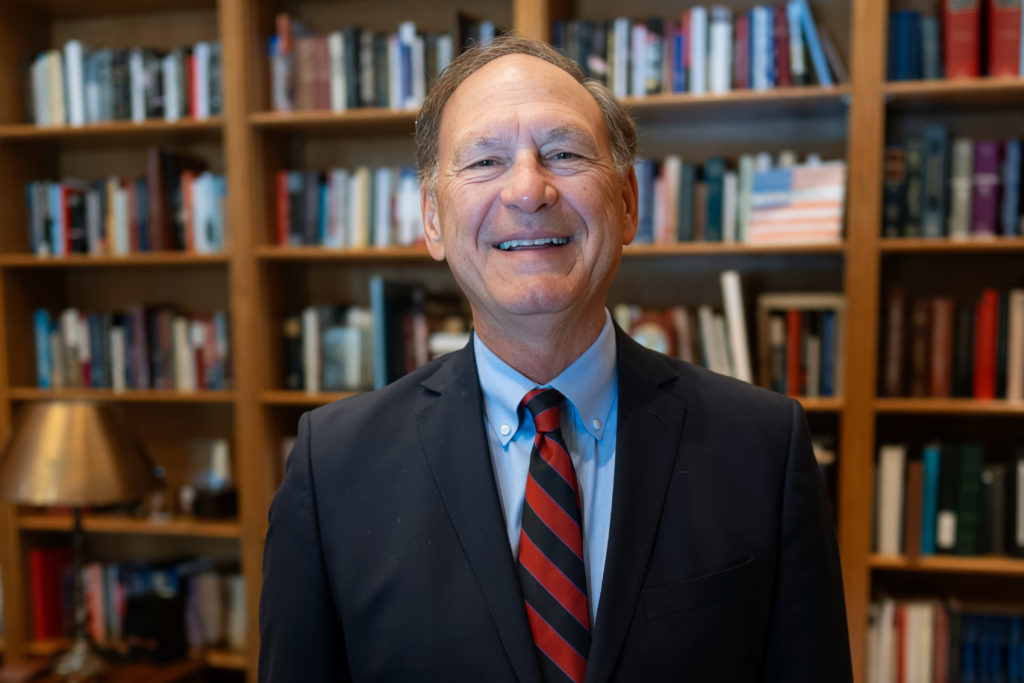
Photo: PBS NewsHour

Supreme Court Justice Samuel Alito, age 76, told CBS News that retirement is a consideration he contemplates each term, indicating he has thought about retiring earlier this year but decided against it. Alito commented on the rise of emergency appeals, stating the Court cannot stem this increase. He also addressed harsh political rhetoric, noting it does not influence judicial rulings but contributes to declining public trust in the Court. Alito remarked that such rhetoric occurs regardless of the sitting president, mentioning Donald Trump, Joe Biden, and Barack Obama. Meanwhile, former President Trump has praised Alito as "one of the Greatest of All Time" while criticizing other justices he appointed. The Court is currently weighing cases including a local government’s lawsuit against oil companies over global climate change. There is concern among some that a potential Democratic Senate majority after the midterm elections could reduce Trump's chances of appointing another Supreme Court justice.

Sourcespbs.orgpbs.orgmotherjones.commotherjones.comreason.comnpr.orgthehill.comreason.com

The takes

  • Portrait of Adam Smith

    Adam Smith

    1723–1790, Scotland (the Scottish Enlightenment: Kirkcaldy, Glasgow, Edinburgh)

    When Presidents Abuse Their Judges

    The loud gain from attacking a court is political, but the quiet loss is the nation’s confidence that law, not faction, decides its fate.

    A judge of your highest court, long on the bench and now of advanced years, has lately complained that he is “not pleased” with the rhetoric of presidents and other great officers when they speak of that tribunal. He observes that the language used to describe the court and its decisions is far harsher than fifteen years ago; that one president may call him one of the greatest, while branding other judges he himself appointed as unpatriotic or hollow men; and that, whatever its effect upon decisions, this continual railing contributes to the public’s declining trust. In his annoyance there is vanity, no doubt; but there is also a public lesson, which is of more importance than his wounded dignity.

    Read the essay


  • Portrait of John Locke

    John Locke

    1632–1704, England (writing amid the Exclusion Crisis and the Glorious Revolution)

    A Court That Lives on Trust Cannot Live Long on Emergency

    When judges speak of rising emergency appeals, partisan appointments, and public mistrust in the same breath, they confess that their power stands in danger of slipping from government to usurpation.

    When I hear that a nation’s highest court “can’t stem” a rise of emergency appeals, while one of its justices publicly laments harsh presidential rhetoric and muses on retirement at a politically charged moment, I do not first ask who will gain or lose by the next appointment. I ask a simpler question: what sort of power is this, and on what trust does it stand? In the Second Treatise I defined political power as a right of making and enforcing laws only for the public good. Wherever power departs from that definition, it ceases to be properly political; it is bare force, which no man, born free and equal, is bound in conscience to obey.

    Read the essay
  • Portrait of Niccolò Machiavelli

    Niccolò Machiavelli

    1469–1527, Florence (republican secretary and diplomat, then exile, amid the Italian Wars)

    A Court That Won’t Fight for Its Own Authority Will Lose It

    When a high judge calls the attacks on his court “offensive” yet insists they change nothing, he mistakes personal dignity for institutional defense—and fortune will not forgive that error.

    A justice of your highest court, Samuel Alito, now 76, tells the public that retirement is something a man his age must consider every term, and that he had already thought of stepping down and chose not to. At the same time, he complains of a surge in emergency appeals and of harsh presidential rhetoric that he calls “offensive,” whether it comes from Donald Trump, Joe Biden, or Barack Obama. One president praises him as “one of the Greatest of All Time,” then denounces other justices he appointed as “unpatriotic” and “merely a shell of their original selves.” The justice replies, in substance: our rulings are unmoved by this noise, though public trust decays. In that contrast lies the whole disease.

    Read the essay